Guide to Flying with Kids: the rundown on ticketing, carseats, strollers and security
- Nov 14, 2018
- 9 min read
Updated: Feb 19, 2019
With summer nearing, I thought it would be a good time to share some information on traveling with kids and the logistics of traveling with strollers and carseats. While there are a ton of posts out there about entertaining your kids on long trips, there's surprisingly little on what to expect when you undertake the overwhelming task of navigating an airport with kids. After four years of frequent cross-country flights with our daughter, my husband and I have our airport routine down to a science and have picked up a few tricks along the way. Below is our guide of what to expect when you fly with kids, along with a few tips and tricks:
(1) Ticketing
If you have a child under 2, you do not need to purchase them a ticket. Children 2 and under can fly on your ticket as a "lap child" or "lap infant" for free on domestic flights and for a small fee on international flights (usually a percentage of the cost of your ticket). If your child is older than 2, they have to have their own ticket.
Things you should know about flying with a lap child:
Your child will be sitting on your lap the entirety of the flight. So, if you are a bigger person this might not be a great option for you. (However, my husband is 6'3" and 250 lbs and he flew with our almost 2 year on his lap several times - it wasn't the most comfortable flight for him, but they were fine.)
Your child will not have a seatbelt. The flight attendants will instruct you to buckle yourself in and your child will sit on your lap without a seatbelt.
You will not get any additional carry-on bags. Since you only purchased one ticket, your child will not be counted as a ticketed passenger so you will only be allowed the normal number of carry-ons - 1 carry on and 1 personal item.
To make a reservation for a lap child, you simply add your child to your ticket as a "lap infant" or "lap child." Most airlines allow you to add a lap child to your ticket on their website as you check out, but some still make you call to add them to your ticket. When you get your boarding passes, your lap child will not have their own boarding pass but their name will appear on your boarding pass.
Many people do choose to buy tickets for their infants or toddlers, but our daughter flew as a lap child until the day she turned two. When she was really little, I would take a sling or a front pack and would keep her in that during the flight. As she got older it was a little harder to keep a wiggly toddler on our laps for an entire flight, but you'll find that flight attendants and other passengers are usually pretty understanding and helpful.
Pro Tips:
If you have 2 ticketed passengers and a lap child, when booking your tickets pick an empty row towards the back and book the window seat and the aisle seat. The back seats of a plane fill up last and a lot of times people won't book the middle seat and you end up with an extra seat in your row that you can put your lap child in! If someone ends up booking the middle seat, you can just trade seats with them - I have never had someone in a middle seat pass up an aisle or window seat.
Get to your gate early and ask the gate agent if there are any open seats. Sometimes they will move you next to an open seat so your child can have their own seat.
(2) Carseats
You have three options when it comes to your carseat: (1) take it on the plane with you, (2) check your carseat at the gate, or (3) check your carseat at the ticketing counter. All of these options are free (or at least I have never heard of an airline that has a fee associated with carseats). I'll go through these options in more detail below.
(1)Taking Your Carseat on the Plane: This is only an option if your child is a ticketed passenger, so this is a no-go if you're taking your infant or toddler as a lap child. If you bring your carseat on the plane, you will have to install it in your child's seat so they can sit in it during the flight.
Pros: Safety - your child will be restrained in case of turbulence or a rough landing.
Cons: You have to take the carseat through security and carry it through the airport then onto the plane which can be difficult when you have other bags and kids. Airplane seats are very narrow so bulky carseats can encroach into neighboring seat space or arm space.
(2) Checking Your Carseat at the Gate: In order to do this, you will have to take your carseat through security and carry it all the way to your gate. When you get to your gate you will go up to the gate agent to get a bag tag for your carseat. Sometimes the gate agent will take the carseat from you then, but most likely you will have to hold onto your carseat until your board your flight and then you will leave the carseat at the bottom of the jetway. Your carseat will then be put under the plane and you will pick it up at the baggage claim of your final destination. Sometimes they will come out on the baggage carousel and sometimes you have to retrieve them from oversized baggage.
Pros: If you have a direct flight, there's probably a lower possibility of your carseat being lost because it only has to make it from the jetway to the bottom of the plane.
Cons: You have to carry your carseat all the way through the airport. Airline could lose or damage your carseat.
(3) Checking Your Carseat at the Ticketing Counter: In order to do this, you just get in line at your airline's ticketing counter before you go through security (same line that you'd go to for boarding passes or to check a bag). Unfortunately, you cannot get a bag tag for a carseat at the electronic/computer kiosks - you have to go talk to a ticketing agent. It's the same process as checking a bag: you just tell the agent you have a carseat, show them I.D., they will print out a bag tag and take the carseat from you right there and put it on the plane. You will pick up your carseat at your final destination either on the baggage carousel or at oversize baggage in the baggage claim.
Pros: You don't have to take the carseat through security and no schlepping of the carseat across the airport.
Cons: Airline could lose or damage your carseat.
We have always checked our carseat at the ticketing counter because I refuse to carry our carseat through the airport along with the 932804 items we always end up traveling with. *Knock on wood* we have never had an airline lose our carseat.
Pro Tips:
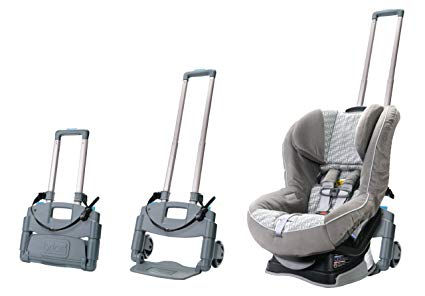
If you are taking your carseat on the plane or checking it at the gate, for toddler carseats you can get a dolly/caddy for your carseat that allows you to strap your child into the carseat and roll your carseat like a suitcase (pictured below).
If you are checking your carseat at the gate or at the ticketing counter, get a protective bag for your carseat. We learned this the hard way when our carseat came back trashed. Invest in a thicker bag that will actually protect your carseat (Amazon sells a bunch of thin nylon ones that are crap). We've had this one for three years and it has held up really well. We also stuff anything we can't fit in our bags into the extra space in the carseat bag.
(3) Strollers
Your options for a stroller are either to check it at the ticketing counter or at the gate. You cannot take a stroller on the plane. As far as I know, all airlines check strollers for free.
Checking Stroller at Ticketing Counter: This is the same deal as checking your carseat, you get in line at the ticketing counter (pre-security), tell them you have a stroller to check, show I.D., they give you a bag tag and take your stroller. You cannot use the electronic kiosks, you have to go get in line and talk to an agent. Your stroller will be checked through to your final destination where you will pick it up at oversized baggage. Definitely get a protective bag for your stroller if you don't want it to come back scratched or torn.
Pros: You don't have to carry your stroller through the airport.
Cons: You can't put your child in the stroller when you're walking through the airport and the airline could lose your stroller.
Checking Your Stroller at the Gate: When you get to your gate, you can go to the counter and get a tag for the stroller (they usually call them "valet tags") or you can wait until you are boarding the plane and ask for a stroller tag when they scan your boarding pass. They will tag your stroller, you will walk your stroller to the bottom of the jetway, collapse your stroller and leave it, and your stroller will be put underneath the plane. When you land, your stroller will be waiting for you on the jetway as you walk off the plane (sometimes it takes a few minutes for them to get the strollers out but the point is you will have your stroller right when you get off the plane rather than picking it up in baggage claim).
You might want to get a protective bag if you have a nicer stroller. Since your stroller is just going a short distance from the jetway to underneath the plane, they are generally not going to get too beat up but our stroller has come back with a few scratches and dings. Word of warning: some airlines have a weight limit on the strollers they will allow you to check at the gate. For example, American Airlines will not allow you to gate check your stroller if it weighs more than 20 lbs. Just make sure to check if your airline has any restrictions if you're planning on taking a bigger (non-umbrella) stroller.
Pros: You have your stroller when you walk through the airport. Less of a chance of your stroller getting lost.
Cons: You have to take your stroller through security and haul it through the airport.
When we fly, we always check our stroller at the gate. It can be a slight pain taking your stroller through security but it is so worth it to be able to strap our daughter into the stroller when we're walking through the airport.
(4) Security
There's a lot that could be said about going through security with kids, but I'll stick to more of the logistics of what will happen when you go through security with kids rather than the rules.
ID Check: Children under 18 do not need an ID when flying with a parent. If you are traveling with a lap child, you should bring a copy of their birth certificate because TSA can ask to see it to verify your child is actually under 2 - we were never asked, but we always brought it anyway. If you are flying with older children, the TSA agent may ask them to say their name or to identify the adults flying with them but usually you just scan their boarding pass and that's it.
Body Scanner v. Metal Detector: When you travel with young kids (under 12), your child and one parent will be sent through the metal detector instead of the body scanner.Kids under 12 can leave their shoes on and coats on. TSA prefers that children who can walk, walk through the metal detector alone but you can always carry your child through the metal detector. Infants can be left in a front pack or sling when you walk through the metal detector. If the metal detector goes off, you will be asked to take the baby out of the sling and walk through again. If you carry a child through the metal detector, TSA may swab your hands so don't be alarmed if you get pulled to the side for extra screening.
Strollers: Your child will have to come out of their stroller when you go through security screening. If you have an umbrella stroller, collapse it and put it on the belt to go through the x-ray machine. If you have a larger stroller that will not fit in the x-ray machine, do not collapse your stroller; a TSA agent will take it from you when you get to the front of the line, do a hand inspection, and swab it. Your stroller will be returned to you on the other side of the metal detector when they are done inspecting it. If your stroller has to be hand inspected and swabbed it can take a few minutes but TSA is generally pretty quick about it.
Carseats: Since virtually no carseats (other than maybe a booster) fit into the x-ray machine, you will have to carry it to the front of the line and give it to a TSA agent for a hand inspection and swabbing. They will return it to you on the other side of the metal detector once they are done inspecting it.
Comment below if there is anything I missed or if there are any other topics you would like me post about!


Comments